The Railjet out of Munich left at half past six in the morning with the kind of punctuality that makes you distrust it. Platform seven, carriage 21, and the conductor checked the ticket twice in the first kilometre, once digitally and once with his eyes, as if the train did not quite believe it was on time either. Outside, the frost was still on the fields west of Landshut, and the coffee trolley appeared before the border had been properly discussed.
The four hours west of the border
The run to Passau takes under two hours, and the river joins the railway somewhere after that, so the landscape and the timetable agree for the rest of the trip. There is not much to do on board and that is the point. A man across the aisle worked through a folder of printed contracts with a pencil, unhurried, and when the trolley came round again he ordered without looking up. "Four hours is a working morning," he said when asked whether the train was slow. "The plane is two hours of nothing in three different buildings."
The border, and the last hour
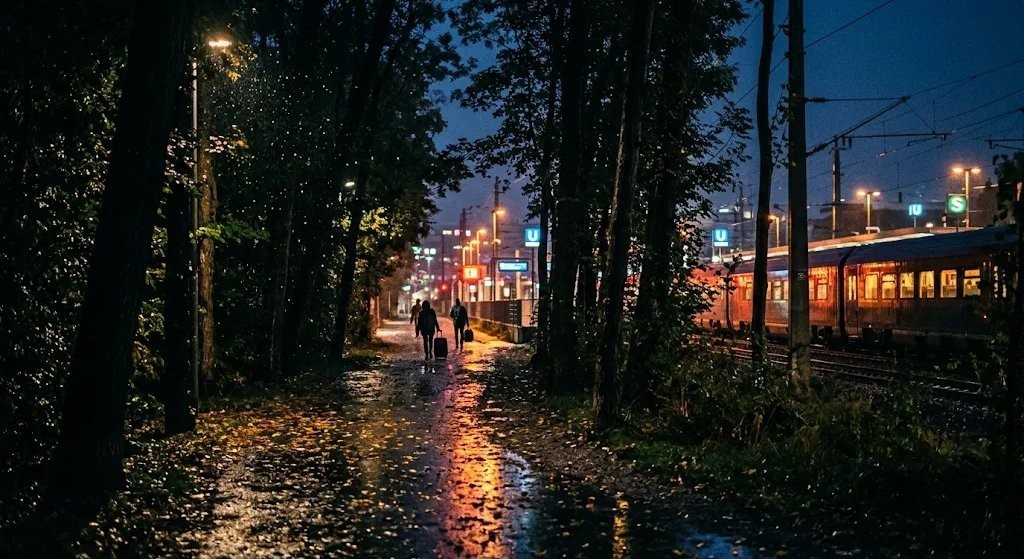
Nobody looked twice at passports. The train slowed through Linz in flat white daylight, filled up with students going as far as Sankt Poelten, and then the announcement came in two languages for the last time: Vienna Meidling, then Vienna Central Station. Meidling arrived three hours and fifty minutes after Munich, to the minute, and the platform stairs put you straight onto the S-Bahn and the U6. A woman with a folded pram took the stairs ahead of everyone, moving like somebody who did this every second Thursday.
Arrival by air, for comparison
The same week, for completeness, involved flying in and landing at Schwechat. The flight itself was shorter than the rail coffee break, and everything after it was not. Doors to train at the airport ran a little over half an hour with the City Airport Train, a few minutes more with the S7, and the walk from gate to platform was long enough that the carry-on got a second opinion from the escalators. Total door-to-door time from the same home city: rail just over six hours, air about four and a half, and the difference shrank again once the airport bus at the far end got stuck behind a tram on the Favoritenstrasse.
The return leg settled the argument more thoroughly than the outbound. Leaving by rail meant walking out of the hotel at seven, coffee in hand, and boarding with two minutes to spare; leaving by air had meant a five-thirty alarm, a bus, a terminal, and a security line that examined a bag of cables with the seriousness of a customs post. For a working week the rail equation is not romantic at all, it is arithmetic: the train sells four hours of usable morning, and the plane sells the same morning to the airport.
What the numbers and the morning add up to
Written as a plan rather than a story, the comparison holds:
- By rail from Munich, Prague, Budapest, Bratislava or Zagreb: under six hours, station-to-centre arrival, full working day either side.
- By air from further afield: Schwechat to the centre in 16 to 40 minutes by CAT, S7 or bus, but add an hour of airport either side.
- For anyone starting the day in a neighbouring capital, the train wins on the whole, not on the speed.
The conductor on the way in had said it plainly somewhere after Linz: the train delivers you to the city, the plane delivers you to the airport. Meidling put us under the city by ten past ten, and the hotel let the bags go before noon. The pencil man from carriage 21 was already gone somewhere into the morning with his folder, and the return leg, booked on the spot, cost less than the coffee trolley receipts had suggested it might. The river kept its side of the window the whole way home.