At twenty past seven on the first morning the coffeehouse on the Wollzeile was already two-thirds full, and the waiter had the newspaper trick down: he brought the paper before the coffee, folded to a page he had guessed from the coat. "Everyone wants the news with the first cup," he said. "The second cup is for the rest of the paper." The coffee arrived thick, on a small silver tray, with a glass of water standing behind it like a chaperone. That glass, it turned out over the week, is the whole philosophy in miniature.
Mornings, marble and newspapers
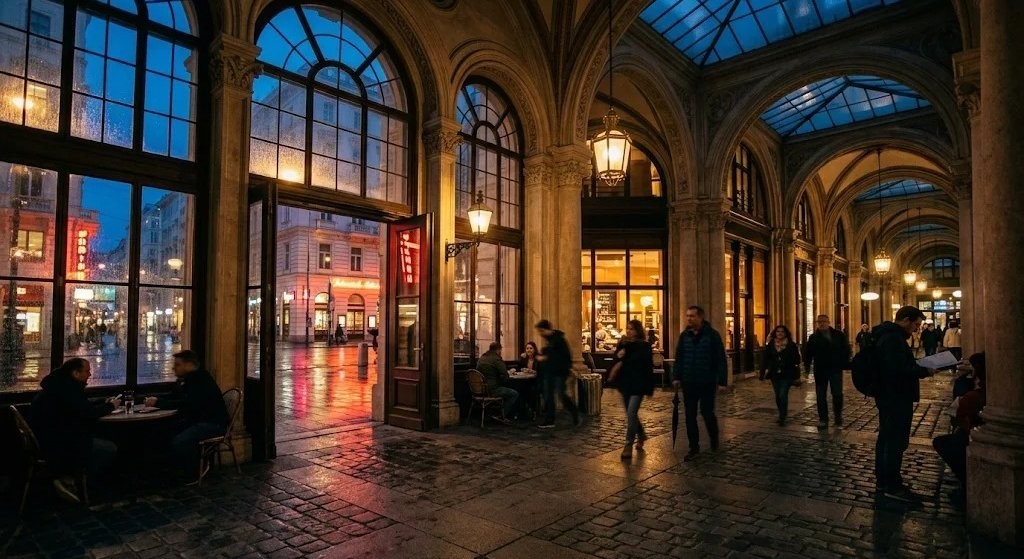
The coffeehouses did not vary much, which was the comfort. Marble tops, bentwood chairs, a coat stand with its own ecosystem, and waiters who addressed strangers with the courtesy of an institution rather than a person. Breakfast was never an event: a roll, butter, a boiled egg in a cup, sometimes a slice of gugelhupf. At a cafe near the university a student occupied one table from opening until lunch over a single melange, and the waiter refilled his water glass four times without being asked. Nobody hurried him. Nobody hurried anyone.
The week tried four coffeehouses across four districts and the pattern held in all of them, which is the quiet achievement of an institution: variation without surprise. Prices differed by a few euros between the tourist squares and the residential streets, and the coffee did not, so the rule that emerged was geographic: drink where the morning takes you, and pay whatever the address costs.
Lunch at the market, in two acts
The Naschmarkt at midday split cleanly in two. The fixed stalls near the Kettenbrueckengasse end served standing lunches: strips of fried cheese, pickles from barrels, bread that had opinions. The restaurants in the middle courted harder, with menu-boards and staff sent to the pavement. The standing end was better and cheaper, and the seating at the permanent tables near the U-Bahn pillars operated on a system a regular explained with two words: "Eye contact." Whoever met the eye of the person leaving got the stool. The whole market ran on that economy.
A second market, the one on the northern square, ran the same economy with smaller crowds and a Saturday branch of the same eye-contact rule. Between the two markets the week's lunches never repeated a stall, and the total bill for five lunches came to less than one dinner in the first district. Planning, in the market's own currency, meant simply showing up before noon.
Evenings, the Beisl and its clock
Dinner was where the week earned its lessons. The Beisln, the small dining rooms with wood panels and daily chalkboards, served a Tafelspitz that had been simmering since morning, and they closed the kitchen when they closed it, mostly before ten. On Thursday the chosen Beisl had no free table and the waiter offered the shared one by the door without ceremony; the two strangers already seated moved their glasses three centimetres, and dinner proceeded. The wine came from the region in small carafes, the bill came with nothing added, and the room emptied by half past nine into a street already quiet.
What the week's notes settled
The practical residue, written on the last morning over the second cup:
- Coffeehouse breakfast needs no reservation anywhere, at any hour, ever.
- Market lunches are best at the standing stalls, cash only, and the stools run on eye contact.
- Beisl dinners need a table booked by afternoon in the busy months; everything else can be decided on the walk over.
That was the week's whole discovery: the city feeds a visitor well by default, and planning is required in exactly one place per day. The waiter with the newspaper had said it first, in his way, on the opening morning: the first cup is arranged, the second is yours. A Vienna eating week works the same. Reserve the one dinner that matters, at the Beisl with the chalkboard, and let the other meals find their own marble tables, their own barrels of pickles, their own two centimetres of moved glass. The glass of water standing behind every cup never once arrived empty, and by Friday that felt less like service and more like the city's own way of keeping an eye on things, standing quietly behind the day, chaperoning it.